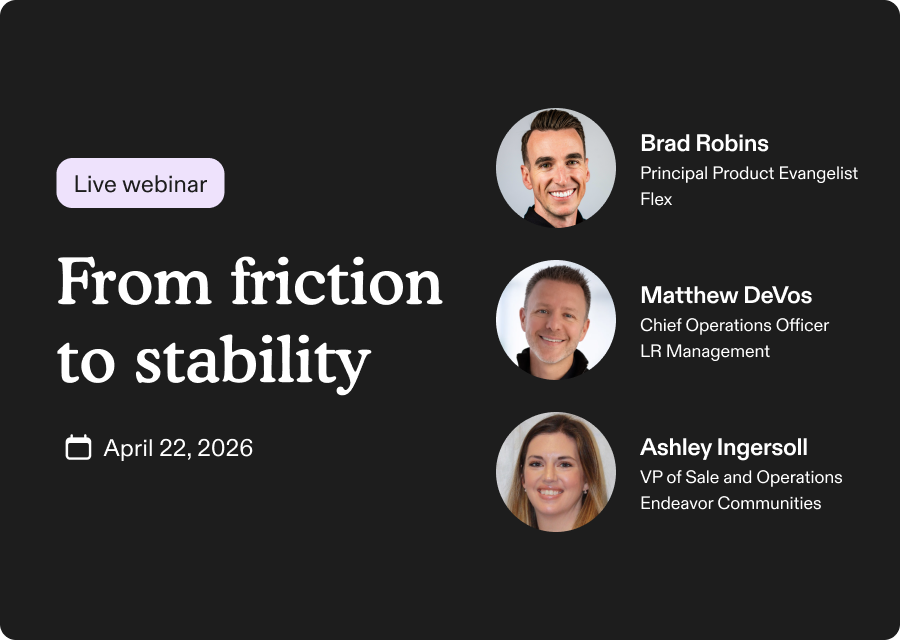
Watch the full webinar here.

Most conversations about NOI start and end with revenue.
Occupancy. Rent growth. Ancillary income. Push the top line, protect the bottom line.
But there's a category of friction that doesn't show up cleanly on a P&L—and it's costing operators more than they realize.
It shows up as rent that takes three follow-up calls to collect. Leases that don't get renewed for no obvious reason. Units that go quiet before anyone knew there was a problem. Hours of administrative time that never makes it onto anyone's report.
These are the holes in the bucket. And most operators have been writing them off as the cost of doing business.
The financial reality your residents are living in
In a recent Flex survey of renters across the country, 75% reported an unexpected financial shock in the last month. More than half said they had three weeks or less of financial runway if their income stopped.
This isn't a Class C problem. It shows up in luxury buildings, student housing, senior communities, and everywhere in between. A small business owner who gets paid slowly by vendors. A W-2 employee whose paycheck timing doesn't line up with the first of the month. A resident who just had a car repair that wiped out their buffer.
None of these people are bad residents. They're just dealing with the same cash flow timing problem that affects most working adults—and rent doesn't accommodate any of it.
What changes when you give residents a real tool
Ashley Ingersoll, VP of Sales & Operations at Endeavor Communities, didn't implement Flex because of a delinquency crisis. Endeavor launched in February 2024 with 47 manufactured housing communities and a clear mission: give every resident a community they want to call their forever home.
"If we're going to ask them for forever, we better have a solution for them when life gets tough."
What they found was that the traditional collections process—calls, texts, door knocks, notices—wasn't holding residents accountable. It was damaging the relationship and driving silent move-outs. Residents who felt embarrassed or cornered didn't complain. They left.
Since implementing Flex, Endeavor has seen a measurable drop in legal fees, fewer silent move-outs, and improved net promoter scores. And $168,000 in rent flows through Flex every month—with roughly 20 new resident sign-ups per month and minimal marketing effort.
"I think it kind of sells itself," Ashley said.
It works across every asset class—here's why
Matthew DeVos, COO at LR Management (67 communities, 16,000 units across Michigan), initially heard the same skepticism from ownership that most operators do: we don't want to attract bad residents.
The concern is understandable. It's also a misconception.
Flexible rent payments don't change who gets approved. Operators still control screening. What it changes is what happens after move-in—when life does what life does.
Matthew's team now promotes Flex at every touchpoint: prospect tours, renewal conversations, and delinquency calls. One recent example: a small business owner who specifically chose an LR Management community because of payment flexibility. Not because he struggles to pay rent—because his cash flow is unpredictable, and he wanted optionality.
Once LR Management's ownership group started seeing results, skepticism turned to enthusiasm fast. Now they're asking for banners, events, and sign-up incentives at move-in.
"It checks all the boxes and solves all the problems," Matthew said.
The retention piece operators underestimate
Based on a recent J Turner research report, over 40% of non-renewals are preventable—with the top reasons being residents seeking a better experience or dissatisfaction with management.
Not the amenities. The relationship.
Endeavor sends renewal notices four months in advance, specifically so residents have time to have honest conversations without urgency—and so Flex is part of the picture before anyone is under pressure. The result: fewer awkward in-person conversations, fewer people who go quiet, and a higher renewal rate.
LR Management uses a similar approach for residents who've had payment challenges mid-lease. Flex becomes part of the renewal offer—a practical solution that lets both sides move forward.
When residents feel like the operator is working with them, not just at them, they stay.
The bottom line
Resident financial well-being and operator financial health are not competing priorities. They're the same priority.
Every piece of friction at the resident level—a missed payment, a stressful collections call, a renewal conversation that never happens—has a real cost on the operator side. And a significant portion of that friction is within your control to reduce.
Flexible rent payments aren't a concession to residents. They're an operational tool that benefits the resident, the management team, and ownership—at the same time.
As Matthew put it: the implementation is effortless. Ashley's team has fielded a handful of support questions since going live in November 2024. The lift is minimal. The compounding effect on collections, retention, and team morale is not.
The bucket has holes. Some are easier to plug than you think.
Read their case studies: Endeavor Communities and LR Management.
Learn more at getflex.com/properties